Monday, December 29, 2008

AMD wanna let Intel wins in quad-core processor?

a new mobile quad-core chipis being introduced , which Acer started offering Monday in its latest Aspire laptop for multimedia and gaming enthusiasts. Where online retailers started offering pre-orders of Advanced Micro Devices (AMD)Phenom II quad-core chip, which AMD plans to introduce next month at the Consumer Electronics Show in Las Vegas, Nev. The new product is aimed at high-end desktops. The Acer Aspire 8930G-7665 laptop is powered by Intel's new Core 2 Quad Q9000. On Sunday, Intel released an updated price list that lists the 2.0 GHz Q9000 for $348 in batches of 1,000. Pricing for Intel's other mobile quad cores start at $851, with the highest price product, the QX9300, listing for $1,038.

Intel also listed four new dual-core processors for laptops, the 2.93 GHz T9800, $530; the 2.66 GHz P9600, $348; the 2.66 GHz T9550, $316; and the 2.53 GHz P8700, $241.

The latest Acer Aspire sports an 18-inch display and includes 4 GB of memory, an Nvidia GeForce 9700M GT graphics card with 512 MB of video memory, and a 500 GB 7200 RPM hard disk drive. The system also includes a Blu-ray disc player, built-in Wi-Fi support, a webcam and Windows Vista Premium. The manufacturer suggested retail price is $1,800.

AMD's 3.0 GHz Black Edition Phenom II X4 9400 was available for pre-order on Computers4Sure, owned by Office Depot (NYSE: ODP); and A-Power Computer Online. The chip comes with a three-year warranty.

the AT& T updates...

Sunday, December 28, 2008

Intel Denies Selling Atom Processors Only in Package with a Chipset

Even though Nvidia Corp. was quoted as saying that Intel Corp. only sells its Atom processors for netbooks and nettops bundled with its own core-logic sets, which is why none of device manufacturers were interested in Nvidia’s Ion platform powered by GeForce 9400M chipset, Intel Corp. denied that it blocks Nvidia from entering the market of ultra low-cost personal computers (ULCPCs).

“We do sell Atom both bundled and as stand alone,” an Intel spokesperson told X-bit labs.

According to Intel officials, Nvidia does not need to obtain a separate license to make and sell chipsets compatible with Intel Atom processors aimed mostly at ULCPCs.

Nvidia recently introduced its GeForce 9400M is a single-chip core-logic for Intel Atom processors with DirectX 10-compatible GeForce 9-class graphics processor inside that also supports dual-channel DDR3 memory, PCI Express 2.0 x16 and x4 links, Serial ATA, USB, Gigabit Ethernet and so on. As all modern Nvidia GeForce integrated graphics processors, the novelty features hardware-accelerated high-definition video decoding and post-processing as well as supports various outputs, such as dual-link DVI-I, D-Sub, DisplayPort or HDMI.

The GeForce 9400M has dramatically better feature-set and performance compared to Intel’s own core-logic sets, but the power consumption of the GeForce 9400M (18W) is more than two times higher compared to Intel’s own platform (Intel 945GSE + ICH7-M consume 6W + 1.5W in maximum case scenario). Moreover, Nvidia’s GeForce 9400M requires expensive DDR3, whereas Intel’s platforms for Atom processors rely on affordable DDR2.

Even though performance and features are definitely advantages for mainstream users, they may not be appreciated by users of netbooks, which come with small screens and without optical disc drives. As Intel pointed out, the whole central premise of the netbook usage is basic Internet, browsing, email, social networking, not gaming or usage of demanding applications. Cost is a huge factor on the market of netbooks, hence, Nvidia’s Ion platform that requires DDR3 memory and higher-capacity batteries may not be the best option for systems like Acer Aspire One or Asustek Computer Eee PC.

Tuesday, December 23, 2008

Microsoft Answers beta website launched


Microsoft has launched a new web site just for Windows Vista users:it's not even for the Windows XP users.
This action means that Microsoft does not care about those Windows Xp users?

Microsoft Answers, currently in beta (the site is often down and under maintenance), is a support forum in the Q&A format. There are three ways of using the service:
  • Use the search bar at the top of the page to find existing answers to your question.
  • Browse specific category pages under find answers.
  • Ask the community how they fixed a problem or how they did something.

The idea behind the website is a great one: have an official forum for Windows tech support that is run by actual Microsoft employees willing to help out users. Furthermore, you can subscribe to your question and be notified via your browser, e-mail, or RSS when there is an answer posted. Unfortunately, signing up is mandatory: there is no way to see questions and answers without being signed in. This is a very bad decision on Microsoft's part; anyone should be able to read the solution to a problem as a guest and registration raises and unnecessary barrier to entry.

I find it very interesting that Microsoft is limiting the website to just Vista-related questions and answers. XP is going out the door, but what will happen when Windows 7 is released? Will the site be divided into two, or will Microsoft convert the site to only cover Windows 7 questions?

Monday, December 22, 2008

Sibu Trip...

We started our bored journey at 5.30 a.m on Sunday.reach Sibu at 10.27a.m..
driving at a constant speed at 120 km/h-140Km/h


Thursday, December 18, 2008

MSN did it againby saying:"You spoke, Hotmail listened"

Over the past year, many of you told us that you wanted a cleaner, faster Hotmail. We released the new Hotmail to meet those needs, and now we're adding more improvements based on your feedback.

In this version, we've changed the way that scrolling works for users who have the reading pane turned off. It'll look more like Classic Hotmail if your reading pane is off.

Even more improvements are coming soon—we'll be moving the advertisement from the top of page to the side, adding more themes, increasing the number of messages on each page, and adding the ability to send instant messages from your inbox.

We appreciate all your feedback and want to thank you for using Windows Live Hotmail.

MacWorld is no more important to Apple .inc including Steve Jobes

So posits a reader that goes by the name MacUser. He points out that:

While Apple is able to host their own events very successfully, I feel that Macworld is really the opportunity for those third Party developers to really show their wares. This eco system of third party developers is part of what makes a Mac so great. I have to believe that this will hurt third party developers and eventually hurt the Mac user’s experience. If their is no headliner Keynote, how many people and big time developers will show up. This is not the same as Apple pulling out of NAB or other trade shows where Apple is just one other big company, this is Macworld, there is no Macworld with out Apple.

It’s a good point. Apple understandably would like to be rid of the need to develop its products on Macworld’s timetable, but lesser companies need the exposure. Sure, the fast-declining role of trade shows generally means this is less true than it was. But at the least, having Apple hold onlyh its own events will give the company even more of a chokehold over which of its partners—particularly ISVs—to promote. Take the 10,000 plus apps now in the App Store, for example. At MacWorld, a small ISV might have a chance to drum up some business on the show floor to the throngs of Jobs-watchers. Now, the only hope is that Jobs will mention their app during one of Apple’s own presentation.

What do you think: Is Apple being self-centered or even short-sighted in its decision to neuter Macworld’s usefulness to the larger Apple ecosystem? Or is it being smart to put a fork in the most famous Apple-related tradeshow, and should ISVs follow its lead and stop investing in tradeshows, as well?

Tuesday, December 16, 2008

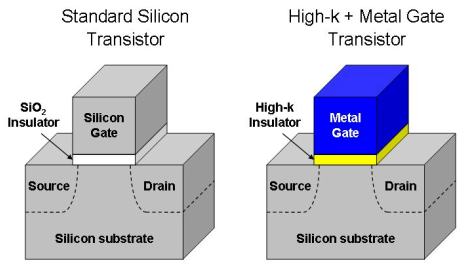
Hi-k in our 45nanometers Processor today


Computer chips have become so dense that packing even more transistors into them is forcing engineers to break long-standing rules of transistor design. Earlier this year, Intel became the first company to get 45-nanometer chips on the market by finding a way to make a transistor with what's known as a high-k dielectric. To make the transistors work, it had to make the first fundamental change to transistor design in nearly 40 years, switching to metal-gate electrodes from silicon. Intel also had to use a new manufacturing process and two different types of metal to make the transistors. Now a team of engineers at Semiconductor Leading Edge Technologies (Selete), a research consortium for Japanese technology companies, says it has worked out a new way of making high-k dielectric transistors that uses the common manufacturing process and only a single type of metal.

A transistor is basically a switch: When you apply voltage to the gate electrode, it opens or closes a channel in the silicon for charge to flow. In an n-type transistor, electrons flow through the channel, whereas in a p-type transistor, it's actually the absence of electrons (usually referred to as holes) that flows. Transistors in microprocessors are usually arranged so that the two varieties work in a complementary fashion. In these transistors, the gate is separated from the chip surface by a silicon-dioxide insulating layer. As transistors have shrunk down over the decades, the oxide eventually became so thin that it leaked electrons through it, wasting power. Since the mid-1990s, chip makers have been experimenting with replacing the silicon dioxide with high-k dielectrics—materials that can be made physically thick (to stop electron leakage) but electrically thin (so that the transistor turns on easily).

But high-k dielectrics have problems of their own. Engineers have found that they work only with metal gates instead of the silicon gates in use since the late 1960s. In a gate made from silicon, engineers dope the silicon with impurities to control whether it is p-type (having excess holes) or n-type (having excess electrons). The gate has the opposite doping as the channel—a p-type gate controls an n-type channel. Metal electrodes can't be doped. Instead, researchers had to search for metals that happen to have an electrical property called “work function,” which makes them behave the same way as the doped silicon. For Intel, this meant two metals: one whose work function matched the p-type silicon substrate and one that matched the n-type.

The Selete group effectively flipped this method on its head, starting with a single metal whose work function falls in between that of p-type and n-type silicon, and using different high-k dielectrics to push the effective work function toward one value or the other. Using only one type of gate metal makes building the transistor easier and helps control important properties of the transistor, according to Yasuo Nara, whose research group presented its findings yesterday at the International Electron Devices Meeting, in Washington, D.C.

Researchers noticed that during one of the critical manufacturing steps in making transistors—annealing—the interaction between the high-k dielectric and the metal gate changed the gate's effective work function. Intel sought to avoid such a change by going against the conventional procedures and adding the gate after annealing.

But researchers at Selete decided to take advantage of the change. Nara and his colleagues found that if they added certain elements to the metal gate, the annealing process drove the elements into the high-k dielectric, changing its composition and predictably modifying the effective work function. For p-type transistors, they added aluminum, and for n-type, they added magnesium. The result was two different high-k dielectrics but only one metal gate.

It's not yet clear if Selete's method is a viable alternative to Intel's technique, but it may be a new way to attack a difficult problem. “We are not sure how Japanese chip makers feel about our results,” writes Nara by e-mail, but “we believe single-metal integration is beneficial for fabrication.”

Accident!happened on the 10th December 2008...

10th December 2008,my grandmother's brother (father side) had involved in an accident at Lundu.
His car was a Range Rover Vogue , thanks that he is still alive...it was totally MAX TOTALED!.Accident with lorry 4tans (6 tyres type).
HERE ARE THE PHOTOS OF THE RANGE ROVER.
just can not forget this...

Sunday, December 14, 2008

THE DRIFT NIGHT....grab from my friend cuz my dad's phone not enuf battery to take these photo..hahaxD

THE DRIFT NIGHT
it's in Kuching....night time of cuz...
a 4x4 stuff........
but ppl go drift right there after they having their closing ceremony for their event this year...
many nice nice car.n i love it..
PLS DON'T TRY THIS AT HOME....ONCE YOUR CAR IS TOTALED...U R GOING TO FACE TROUBLES FROM POLICE,PARENTS,FRIENDS,HOSPITALS!!!
HAHA

VIDEOS COMING SOON On yotube.com
enjoy those pic..


some events that is rarely seen in the public n some
enterter


DOULOS

haihz....
bored school holiday
on the 10 December 2008 morning, DOULOS had just reach Kuching .
This is the last time for this old DOULOS ship to "pass by" around the world.
GOTTA SAY GOODBYE...


pic (above)
PS:I love the girl on the most left..she is so..beautiful.i think i had fallen in love at my 1st sight!!!


Saturday, December 13, 2008

looking Intel's future!!!car batteries...

Grove, who led Intel through its most successful growth face in the 1990s, mentioned this idea during a conversation with the Wall Street Journal. In his view, Intel should take advantage of a major business opportunity and become a leading manufacturer of advanced batteries for plug-in electric vehicles.

According to Mr.Grove, who retired in 2005, still advises Intel’s leadership, as does Gordon Moore, and he is apparently urging the current CEO Paul Otellini to lead Intel go into the battery business. As of now, it is unclear if Otellini will follow Grove’s advice, but if he did, it would certainly be a rather unusual strategic move for Intel.

In the early 2000s, Intel tried to become a consumer electronics manufacturer with Intel-branded toys and MP3 players. The strategy was quickly shelved again. And more recently, Intel sold off business units that did not directly fit into its core business of microprocessors, chipsets and wireless chips anymore. Intel has been expanding again more recently, but focused on areas that are closely tied to its chip business – for example the upcoming Larrabee discrete graphics card. After selling its Xscale mobile processor business in 2006 to Marvell, the company recently tried to come up with a much more convincing product, the Atom processor, but may hit some roadblocks with its MID platform idea.

The charismatic Grove, now 72, is known as one of the brilliant minds in Silicon Valley and he may have the right idea with his envisioned battery business – a product category car manufacturers are clearly struggling with. The 2010 Chevy Volt, for example, is rumored to only achieve one hour of battery time from its battery unit. Grove is also known to be interested in cars, driving a tweaked Toyota Prius plug-in hybrid.

If Intel really goes into battery manufacturing, the company has options to do this via an investment, a joint-venture or all by itself. There is no question that Intel can afford to go into this business. However, some may doubt that such a move actually makes sense.

Thursday, December 4, 2008

"virtualization"

Normally,we call software such as Virtual Machines and Parallel Desktop as our "virtualization" which occurs in our computers "virtually" combine two Operating System together in order to comfort the customers.Some computer users today loves to do things at once (called multitasking).This doesn't make any sense for some time in the old days...

With the multi-core processor , they have give a birth to these virtual in Macs and Linux.They really did a good jobs for the public who really multitasking their brain.These people need at least two Operating System to complete their task in a shorter time limit given.So, "Virtualization" occurs.Excellent hardware and even better software are strong reasons for people to choose a Mac as their next computer. Many, no doubt, would also like to leave the world of Microsoft Windows behind. If you're not quite ready to take that step, or work realities make it impossible, you actually can have your cake and eat it too. For some time now, Macs have had the ability to run the many applications written for Windows, thanks to Apple software called Boot Camp. But you have to choose between Windows or the Mac OS X at startup and you end up with two separate systems sharing one physical computer. I suspect most Boot Camp users are running intense Windows-only games and want the maximum performance on Apple hardware.

technology with the user-unfriendly name of virtualization provides a much better answer. New versions of two very good products such: Parallels Desktop for Macintosh 4.0 and VMware Fusion 2.0 (the prices for both is $80USD).
Both these software is design to let you run Windows programs on a Mac so that they look almost exactly like OS X programs and behave that way, too.

To use Parallels and Fusion, which require less technical proficiency than earlier versions, you need a fairly recent Mac and a copy of Windows. Once you have installed the software, you follow the on-screen instructions to set up a Windows "virtual machine." Then you install the Windows programs you need, and you're good to go.

I think the application that is the biggest deal for business Mac users is Microsoft Outlook. The Mac alternative, Microsoft Entourage, is a less-than-satisfactory substitute for Outlook's mail, contact, and calendar functions. Entourage lacks Outlook's small business contact manager. Critical collaboration features of the Microsoft Exchange corporate mail system are also missing.

Fusion and Parallels both offer three different ways to run Windows. You can turn your entire Mac display into a Windows desktop. You can run the Windows desktop in a separate pane. And, in perhaps the best approach, you can run each Windows program so it looks like a regular Mac application.

Fusion and Parallels also let you share files between OS X and Windows. And they can be set up so the contents of key folders, such as Documents and Pictures, are duplicated in both systems. This makes it easy to save an attachment in Outlook and use it in a Mac application, or vice versa. The result? Workplaces that have been hostile to Macs may relent. Without much effort, a company can clone its standard Windows setup, including all security policies, and install it as a virtual machine on a Mac that then lets employees access the corporate network.

The implications of virtual machines may go beyond the traditional Mac-vs.-Windows competition. VMware and Parallels make versions that let you install Windows virtual machines on any Windows PC. It sounds illogical but makes some interesting things possible. You can run two completely separate systems on the same hardware—one for secure corporate use, the other loaded with personal programs the company doesn't want to support. Computers of the not-too-distant future may include virtual machines with dedicated jobs, such as a secure setup used only for online finance and another for Web browsing.

Complicated software and the limitations of earlier microprocessors restricted the use of virtualization. Now, with simpler software and much more powerful computers, the age of virtual machines has arrived.

These softwares are "Beyond Tommorow"in the old days.But Now, Many people on this world enjoy their work with their heavy tasks given by their bos.


WE SHOULD THANKS TO THESE SOFTWARE WHICH ALLOW US TO DO OUR WORKS MORE EASY.

Wednesday, December 3, 2008

what world best anti-virus cann't do?

With the ever changing of the new media and technology, it is no surprise that frauds and threats has been changing too. Even now, they go high tech path and that is the tool we use everyday called the internet. There are many kind of frauds and threats but they all have the same objective, that is to harm your computer or indirectly to you.

Threats

Threats would be referring to Virus threats. It harms your computer by destroying the data within the computer. That's the reason why firewall and anti virus software are created. However, even with best firewall and anti virus software program you may not be safe. By learning how to configure the firewall and anti virus software properly, you are reducing the chance of getting infected. We all have to play a part in order further reducing the chance of getting infected.

Be alert when ever trying to send you weird looking web link or files. Here's an example of weird looking web link.


Notice the web link? You will be infected with viruses such as Trojan, worms or other kind of malware if you click on the link above. If you ever encounter this kind of web link, best solution is to close the chat window immediately. If your friend or some other people sent you a file and are unsure of the weird extension at the end of the file name, don't accept it as the file might contain viruses or malware.

Cyber Frauds

Cyber frauds causes harm indirectly to you. Their main aim normally are to get information from the user or phishing of your ID & passwords (stealing and misuse of your identity) or even cheat your money through an online auction.

Some of the frauds are interested in the information such as your bank account number. Firstly they will try to gain your trust through an article, stating that you will receive an amount of money if you witness some transaction and then they will ask for your bank account number. Such frauds cases are normally similar to Nigerian mail. Best solution is to ignore and delete the mail.

One of the most common website to get your money cheated is ebay. If you wanted to buy something from ebay, think twice before you hit the 'buy it now' button. Some of the item price is really attractive but the actual fact is, the price is too good to be true.

No matter how many positive feedback the seller has, it still won't tell you that he don't cheat on you as feedback can be done by the seller itself or using some software devices. An example will be Sony Vaio laptop, notice the price? It is too good to be true.


How to avoid been cheated? Best solution, if the price is too good to be true then don't buy it. If you happen to bought it and you realize is a fake good, immediately ask for refund and send the item back to the seller. If they turn down the refund request then treat it as an lesson and learn from it.

There's another kind of frauds which is using a fake website to phish your ID and passwords. The most recent case of such frauds is the fake DBS bank website. To prevent phishing, what we can do is to look and observe the website carefully.


Notice the security lock? Only authentic website will have it and to prove that the website is secured (the website need to subscribe to SSL in order to have the website secure). It is best to know whether the website is secured before you do any login process.

Summary

Relying on Anti-virus software or firewall itself is not enough. The best remedy for any diseases is prevention, same goes for computer. For cyber frauds, if you receive article similar to Nigerian mail, without hesitation just delete the mail right away. For online auction fraud, just have to be careful on what you are buying. If the price is too good to be true, then don't buy it. Lastly, remember to check the website that they have the security lock icon!

Hope you guys know more about viruses and fraud after reading this article. Thanks for viewing!