


 that's a handphone without a keypad or keyboard...so,customer have to gotta get some keyboard fix it on the screen of the phone.this way, makes money for the company as the customer put their keyboard on screen .
Here’s a great example of the intelligence that drives R.I.M.: The phones all have simple, memorable, logical names instead of incomprehensible model numbers. There’s the BlackBerry Pearl (with a translucent trackball). The BlackBerry Flip (with a folding design). The BlackBerry Bold (with a stunning design and faux-leather back).
Well, there’s a new one, just out ($200 after rebate, with two-year Verizon contract), officially called the BlackBerry Storm.
But I’ve got a better name for it: the BlackBerry Dud.
The first sign of trouble was the concept: a touch-screen BlackBerry. That’s right — in its zeal to cash in on some of that iPhone touch-screen mania, R.I.M. has created a BlackBerry without a physical keyboard.
Hello? Isn’t the thumb keyboard the defining feature of a BlackBerry? A BlackBerry without a keyboard is like an iPod without a scroll wheel. A Prius with terrible mileage. Cracker Jack without a prize inside.
R.I.M. hoped to soften the blow by endowing its touch screen with something extra: clickiness. The entire screen acts like a mouse button. Press hard enough, and it actually responds with a little plastic click.
As a result, the Storm offers two degrees of touchiness. You can tap the screen lightly, or you can press firmly to register the palpable click.
It’s not a bad idea. In fact, it ought to make the on-screen keyboard feel more like actual keys. In principle, you could design a brilliant operating system where the two kinds of taps do two different things. Tap lightly to type a letter — click fully to get a pop-up menu of accented characters (é, è, ë and so on). Tap lightly to open something, click fully to open a shortcut menu of options. And so on.
Unfortunately, R.I.M.’s execution is inconsistent and confusing.
Where to begin? Maybe with e-mail, the most important function of a BlackBerry. On the Storm, a light touch highlights the key but doesn’t type anything. It accomplishes nothing — a wasted software-design opportunity. Only by clicking fully do you produce a typed letter.
It’s too much work, like using a manual typewriter. (“I couldn’t send two e-mails on this thing,” said one disappointed veteran.)
It’s no help that the Storm shows you two different keyboards, depending on how you’re holding it (it has a tilt sensor like the iPhone’s).
When you hold it horizontally, you get the full, familiar Qwerty keyboard layout. But when you turn it upright, you get the less accurate SureType keyboard, where two letters appear on each “key,” and the software tries to figure out which word you’re typing.
For example, to type “get,” you press the GH, ER and TY keys. Unfortunately, that’s also “hey.” You can see the problem. And trying to enter Web addresses or unusual last names is utterly hopeless.
Furthermore, despite having had more than a year to study the iPhone, R.I.M. has failed to exploit the virtues of an on-screen keyboard. A virtual keyboard’s keys can change, permitting you to switch languages or even alphabet systems within a single sentence. A virtual keyboard can offer canned blobs of text like “.com” and “.org” when it senses that you’re entering a Web address, or offer an @ key when addressing e-mail.
But not on the Storm.
Incredibly, the Storm even muffs simple navigation tasks. When you open a menu, the commands are too close together; even if your finger seems to be squarely on the proper item, your click often winds up activating something else in the list.
To scroll a list, you’re supposed to flick your finger across the screen, just as on the iPhone. But even this simple act is head-bangingly frustrating; the phone takes far too long to figure out that you’re swiping and not just tapping. It inevitably highlights some random list item when you began to swipe, and then there’s a disorienting delay before the scrolling begins.
There’s no momentum to the scrolling, either, as on the iPhone or a Google phone; you can’t flick faster to scroll farther. Scrolling through a long list of phone numbers or messages, therefore, is exhausting.
Nor is that the Storm’s only delayed reaction. It can take two full seconds for the screen image to change when you turn it 90 degrees, three seconds for a program to appear, five seconds for a button-tap to register. (Remember: To convert seconds into BlackBerry time, multiply by seven.)
In short, trying to navigate this thing isn’t just an exercise in frustration — it’s a marathon of frustration.
I haven’t found a soul who tried this machine who wasn’t appalled, baffled or both.The number one reason for upgrading to Opera Mini 4.2 -- perhaps the only real reason you need -- has to do with performance. Opera promised a 30% speed increase as a result of throwing the switch two weeks ago for its proxy server farm for the US. That's where a lot of Opera Mini's real functionality actually lies -- it's where some of the more difficult Web page graphics get crunched down to size, for instance.
We didn't need a stopwatch. Prior to upgrading to 4.2, our page performance during business hours for OM 4.1 was so pitiful that many pages would not even load to completion -- BetaNews itself among them. Today, we noticed page loading performance that actually transcended into the "acceptable" range -- still a few thumb twiddles, but nothing requiring strong analgesics.
 Another much touted feature for version 4.2 is "skinning," and for a desktop PC user, that term implies a great deal of customization. For Opera Mini, whose most convenient mode for reading the screen is often full-screen mode, skinning frankly isn't all that important. There's a title bar over the window when you're not in full-screen mode, and skinning here allows you to change that color to any of a handful of others. It's not something to write a press release about (although these days, whenever Google changes the color of something, it does tend to take after Sir John Gielgud in "Arthur" and "alert the media").
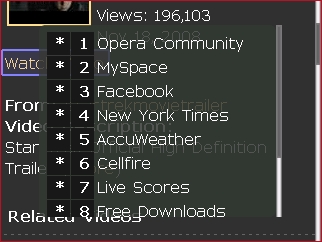 Speaking of full-screen mode, changing to that mode still requires a trip through the menu system -- specifically, the Settings panel. For more convenience, there should be a hotkey that turns on and off full-screen mode, so users can get rid of the title bar when necessary. Right now, Opera Mini's hotkeys are dialed up using a * sequence, and they're reserved for most-used bookmarks -- what OM calls "speed dial." It would be convenient if users could also assign a program function to this list, and full-screen mode would be my nominee.
UPDATE One BetaNews reader contacted us this evening to say the * * key sequence -- which doesn't work for us, even now -- is working for him on his BlackBerry 8100 running OS 4.2.
 The other major change in OM 4.2 is improved support for video; though unfortunately, your device of choice needs to support it first. Support for YouTube video is coming for existing Verizon BlackBerry users in OS 4.5. Until then, awkwardly, whenever OM 4.2 tries to launch a video, it launches the BlackBerry built-in browser instead.
In our particular situation, Opera Mini improved enough to enable us to be comfortable with using it every day in place of BlackBerry's built-in browser. And that's a good enough qualification for recommendation.
 Picture:A Cruzer Titanium Drive Opened after being nearly destroyed.
A company owned jointly by Intel and memory maker Micron Technology started mass producing NAND flash memory chips using tiny 34-nanometer technology, the companies said Monday.
NAND flash memory is used to store songs, movies and more in iPods, iPhones and a range of other consumer electronics goods.
The Intel-Micron joint venture, IM Flash Technologies, expects 50 percent of the chips at its factory in Lehi, Utah to be made using 34nm technology by the end of this year.
The nanometer measurement describes the size of the smallest transistors and other parts that can be manufactured on a single chip. There are about three to six atoms in a nanometer, depending on the type of atom, and there are a billion nanometers in a meter.
Chip makers such as Taiwan Semiconductor Manufacturing (TSMC) and Intel currently mass produce chips using technology as tiny as 40nm to 45nm. Generally, the more transistors on a chip and the closer they are together, the faster the chip can perform tasks.
Aside from performance, companies are working to make chips smaller and less expensive because people want ever-smaller, cheaper devices.
IM Flash is manufacturing 32G byte NAND chips the size of a thumbnail with its 34nm technology, and expects the chips to be used in small solid-state drives (SSDs) or flash memory cards aimed at products including digital cameras, digital camcorders and personal music players.
The 32G byte chips are multi-level cell (MLC) chips, which means they can handle more rewrites than the single level cell (SLC) variety of NAND flash.
Samsung Electronics, the world's largest NAND flash memory chip maker, is currently upgrading its chip factories to use 42nm technology and plans to start 30nm production next year.
The company showed off a multi-level cell 64G byte NAND flash memory chip made using 30nm manufacturing technology last year.


 Picture:The second-generation iPod Touch uses a slightly faster processor than the iPhone 3G.
Apple appears to have upped the processing speed of the iPod Touch in order to help it go after the portable-game market.
Touch Arcade reports that the applications processor inside the iPod Touch (se unveiled in September is actually running faster than the processor inside the iPhone 3G, which runs at the same speed that the original iPhone and iPod Touch used. The new iPod Touch's ARM-based processor is running at 532MHz, while the iPhone 3G's processor runs at 412MHz.
A game developer interviewed by Touch Arcade noticed a huge difference in 3D-rendering speed as a result of the speed bump. As we remember fondly from our "megahertz madness" days of Intel-AMD competition in the PC, processor speed is not the only measure of performance, but it is an important one.
With the arrival of the App Store, Apple has been marketing the latest iPod Touch as a gaming device in its latest round of commercials, almost completely ignoring the fact that it's a music and video player as well.
It seems that Apple has room to boost the clock speed of the processor to 620MHz,according to ARM's specifications, but that requires striking a balance between performance and battery life.

At a middle school in Arlington, VA, students stay after school to create their very own podcasts, containing original poetry, essays, and stories, all mixed to music and other sounds. Another school in Arlington, this time an elementary school, uses podcasts to broadcast student reports about the monuments in Washington. One student controls the computer, while another served as the director, and a third recited her report into a microphone. This podcast was discovered by a elementary school in Scotland, and now the two schools “podcast each other.”
Yet another teacher uses podcasts to make recordings of vocabulary words, where they listen to the words over and over. They then create their own podcasts of the words, comparing their pronunciation to the teacher’s.
Podcasting in schools is becoming more and more popular, but still only a small percentage of teachers actually utilize iPods and podcasting in class. However, the potential which iPods possess for assisting learning is undeniable, and will find its way into more and more classrooms in the coming years.


Microsoft Corp. said it will offer free software to protect PCs from viruses, in a move that could pose new challenges for independent makers of security software.
OHW? IS IT TRUE OR FALSE!?
The Redmond, Wash., company said it plans to introduce its security software, code-named Morro, during the second half of next year in an effort to persuade more users to secure their PCs against spyware, viruses and other forms of "malware." Use of antimalware software is far from universal, especially in emerging markets.
WOW.......WHAT THE......
MICROSOFT SCARED OF MALWARES WHICH DESTROY THEIR OPERATING SYSTEM?
There are two primary reasons consumers supply for not protecting their PCs, including a concern that the anti-malware software will bog down their PCs, said Amy Barzdukas, senior director of product management for the online services and Windows division at Microsoft. The other reason is the cost of security software, which can run $75 for the programs plus two years of updates.
I THINK BILL GATES GOT SOME PLANS IN EARNING MORE MONEY FROM HIS PRODUCT!
Morro will replace another security software program Windows Live OneCare, a broader suite of software and services. Microsoft will discontinue retail sales of that software, which costs consumers $49.95 a year, on June 30 of next year.
That's a lot of money dear....I don't think the nation should waste their money for Bill Gates!
The shift to a free security offering from Microsoft could be a problem for Symantec Corp., McAfee Inc. and other independent security companies that charge consumers for their products.


 the cell had die for me to grow older?
 the printer had stop working for a moment when i celebrate my Birthday during the midnight!


Intel Core i7 is a family of three Intel Desktop x86-64 processors. Core i7 is the first Intel family to be released using the Intel Nehalem microarchitecture and is the successor to the Intel Core 2 family. All three models are quad-core processors.The Core i7 identifier applies to the initial family of processors. codenamed Bloomfield. The moniker Core i7 does not have a deeper meaning, but continues the use of the successful Core brand.
Intel announced that the family is due to be launched on November 17, 2008
Intel released official pricing information on November 3, 2008 and the first benchmarks also appeared online.
Nehalem represents the largest architectural change in the Intel x86 family since the Pentium Pro in 1995. The Nehalem architecture has many new features. The ones that represent significant changes from the Core 2 include:
The most serious drawback to Core i7 is the lack of ECC support at least in all current motherboards. For this reason alone, it is advised by some experts, such as Daniel Bernstein, that Core i7 not be used for scientific computing, and not unless you don't mind errors in your critical data.
The second most serious drawback to Core i7 is the lack of inexpensive DDR3 memory on the market.

A 2.93 GHz Core i7 940 system has been used to run a 3DMark Vantage benchmark and gave a CPU score of 17,966.The 2.66 GHz Core i7 920 scores 16,294. An earlier generation Core processor, 2.66 GHz Core 2 Quad Q9450 scores 11,131.
AnandTech tested the Intel QuickPath Interconnect (4.8 GT/s version) and found the copy bandwidth using triple-channel 1066 MHz DDR3 was 12.0 GB/s. A 3.0 GHz Core 2 Quad system using dual-channel 1066 MHz DDR3 achieved 6.9 GB/s.
Overclocking will be possible with the 900 series and a motherboard equipped with the X58 chipset. In early October 2008, reports surfaced that it will not be possible to use "performance" DDR3 DIMMs that require voltages higher than 1.65v, because the integrated memory controller within the Core i7 will be damaged.Some tests however have demonstrated that the voltage limit does not apply, like on an MSI board, and manufacturers can choose to bond CPU voltage to memory or not. By the end of that month, Performance memory vendors had announced 1.65v DDR3 memory kits with speeds up to 2GHz.
Some early articles suggested that i7's design is not ideal for gaming performance. In a test done on leaked hardware, a Core i7 940 compared to a QX9770 shows the Core i7 is slower than Yorkfield clock for clock in 2 games while being faster in the other two. Difference in all cases are small. However, more recent testing done on all speeds of official hardware with final drivers and BIOS reveisions show that Core i7 at the very least beats Yorkfield clock-for-clock, and in most cases exceeds it by an average of about 17%.
In the single-threaded Super PI 1M test, a Core i7 920 running at 2.66 Ghz finished the test in 15.36 seconds, while a QX9770 (3.2 Ghz) did the test in 14.42 seconds,so the Core i7 executed 20% more instructions per clock cycle on this test.
The Core i7 has three memory channels, and the channel speed can be selected by setting the memory multiplier. However, in early benchmarks, when the speed is set higher than a threshold (1333 for the 965XE) the processor will only access two memory channels simultaneously. A 965XE has higher memory throughput with 3xDDR3-1333 than with 3xDDR3-1600, and 2xDDR3-1600 has almost identical throughput as 3xDDR3-1600.
Since the Core i7 is a quad-core processor, Hyperthreading cannot yield any performance improvement for application workloads with fewer than five simultaneous threads when all the cores are fully powered on, and some applications will suffer a performance degradation when hyperthreading is enabled.Hyperthreading will provide its best improvement when the workload has eight or more simultaneous threads.


However, the idea of a Mac Mini has always appealed to me. Reuse hardware like monitors, keyboards, and mice and get into the Mac OS X on the cheap, right? They’re incredibly tiny and use less power than the average laptop, so they can be thin clients, kiosks, web servers, file servers, print servers, media servers, etc. They even have built-in wireless, so they are easy to locate.
They have, however, largely become Apple’s redheaded stepchildren, left to linger in a little corner of the Apple store with no real hope of updates.
Back to the AppleInsider article, though, and we see there might be hope for these slick little machines , opening the door for more inexpensive options for us cash-strapped, Mac-loving ed tech folks. According to the article,
Apple appears to be taking its policing of the rumor mill to the phones, in one case dialing a customer who expressed concern over Internet reports on the Mac mini’s fate to assure him the situation would be addressed in due time.
The real question, though, is should we in Ed Tech abandon this platform? After all, it’s really cheap to build mini computers running friendly versions of Linux. Thin clients can be rolled out fairly cheaply as well. If you’re in the market for higher end hardware, then Macs offer plenty of options at a competitive price with similarly configured PCs. However, if you, like many of us in Ed Tech, are on the lower end of the hardware purchasing scale, is the Mac Mini really relevant? Again, according to Apple Insider,
One of those feature revelations, to which AppleInsider can lend a nod, suggests that Apple will offer new options that will allow the systems to better cater to the server and storage markets for which they’ve become extremely popular.
“In ordering a Mac mini from Apple, there will be an option to have two SATA HDDs and eliminating the optical all together,” the report said. “With the new Remote Disc introduced with the Macbook Air, this option will be tempting for many.”
Will the price come down, too, if Apple introduces a Mini refresh? I love Macs, but at these prices, for their capabilities, I’m just not sure that some homegrown micro ATX-based Linux boxes wouldn’t serve us better in this market.
THE MAC MINI'S RAM

The sophisticated cyberattacks has prompted a federal investigation, Newsweek reported Wednesday. Attacks on both campaigns were similar in that investigators believed a foreign entity or organization sought to steal information on policy positions. Such information could be used in negotiations with the future administration.
Tech experts at the Obama headquarters initially believed that the computer systems had been invaded by a computer virus. The next day, however, they were told by the FBI and Secret Service that the problem was far more serious, the magazine reported. "You have a problem way bigger than what you understand," an agent told Obama's team, according to Newsweek. "You have been compromised, and a serious amount of files have been loaded off your system." Federal agents told Obama's aides that the McCain campaign had suffered a similar attack, which a top McCain official later confirmed to Newsweek.


When he opened it up, he determined that there was a bunch of thermal gel that wasn’t applied very cleanly. (TUAW documented this in February 2006.) By using something called Arctic Silver 5, he was able to run the MBP a lot cooler — but admittedly much louder now.
It is now a laptop despite Apple selling me a notebook. Gone are the sweaty, clammy palms, the typing on a heat pad feeling, the amazed stares of those who touched the bar between the function keys and the display hinge to feel the bite of a working MBP.
Apple tells Mac mini fan to hang in there
  |


Google has begun distributing a patch to its Android mobile phone operating system, an early test for how nimbly the company can respond and how well the infrastructure works to distribute and install updates.
For the Android test phone , a T-Mobile G1, the update was smoother than the process by which the software problem came to light publicly on October 24.
The handset testing gave a message Saturday afternoon: "A system update is available," and a choice to update now or later.But when clicked the button to begin the update, it downloaded new software, which took a few minutes, then installed it, then resumed working with no hitches.
The patch fixes the highly publicized security problem with Android's Web browser and makes a few other minor changes, according to a Google spokesman quoted in IT World on Friday.
The researchers--Charlie Miller, Mark Daniel, and Jake Honoroff of Independent Security Evaluators--called the Android Web browser flaw serious, but Google said its severity was mitigated by Android's design, which restricts each program to its own area.
Earlier, Google appealed for what it called "responsible disclosure" of security vulnerabilities--in other words, a grace period to fix problems before they're made public to reduce the likelihood an attacker will get a chance to exploit a vulnerability. There's an ages-old tension between companies that want to fix their products and security researchers who want to get the word out, in part because attackers also are trying to find the vulnerabilities.
Google didn't respond to a request for comment Saturday.


